AIAugust 14, 2026 · 8 min read · AI-VORTEX Team
GDPR-Compliant AI for Internal Documents in Germany: The Complete 2026 Guide
How CTOs and CISOs in Germany can deploy GDPR-compliant AI for internal documents without losing data sovereignty. A practical guide to private RAG architecture.
- Date
- August 14, 2026
Every week, another enterprise CTO asks the same question: "We want to use AI to query our internal documents, but how do we do it without violating GDPR, losing data sovereignty, or exposing sensitive business data to a third party?"
It's the right question. And in Germany, where DSGVO enforcement is among the strictest in Europe, and where data sovereignty is not just a legal requirement but a competitive signal, getting the answer wrong can cost you far more than a compliance fine.
This guide is written for CTOs, CISOs, and Operations Directors in regulated industries who need a practical, technically grounded answer. No buzzword fluff. No vendor pitch dressed as editorial. Just an honest breakdown of what works, what doesn't, and why the architecture matters as much as the tooling.
Why "Standard" AI Tools Fail the GDPR Test
When teams reach for ChatGPT, Claude, or Microsoft Copilot to query internal documents, they create an immediate compliance problem: your data leaves your infrastructure and enters an external AI provider's training pipeline, or at minimum, their processing environment.
Under GDPR Article 28, any processor handling personal data on your behalf requires a valid Data Processing Agreement (DPA). Under Schrems II, transfers to US-based providers require careful scrutiny of Standard Contractual Clauses and supplementary measures. For healthcare data under §203 StGB, for financial data under MaRisk, and for legal documents under attorney-client privilege, the risks compound rapidly.
The problem isn't that AI tools are bad. The problem is that generic AI tools were not designed for the sovereignty requirements of regulated European enterprises. They were designed for consumers and US-market SaaS companies.
What GDPR-Compliant Document AI Actually Requires
To be genuinely GDPR-compliant when deploying AI for internal documents, you need four guarantees:
1. Data Residency in the EU or On-Premise
Your documents, and all embeddings, vector representations, and model outputs derived from them, must remain within EU jurisdiction or, ideally, within your own infrastructure. A "EU region" option on a US-headquartered provider is not sufficient if parent company access is possible under CLOUD Act requests.
2. No Third-Party Model Training on Your Data
Your documents must never be used to train, fine-tune, or improve any external AI model. This requires contractual guarantees, technical enforcement (air-gapped or on-premise deployment), and audit-ready documentation.
3. Source-Verified, Auditable Answers
Under GDPR's accountability principle (Article 5(2)), you must be able to demonstrate how AI-generated decisions or summaries were produced. This means every AI answer must cite its exact source document, so compliance teams, data protection officers, and auditors can verify the reasoning chain.
4. Access Control Aligned to Your Existing Permissions
AI cannot surface documents that a user is not already authorized to see. The AI layer must inherit and enforce your existing role-based access controls, not bypass them.
The Architecture That Makes It Work: Private RAG
The technology that enables GDPR-compliant document AI at scale is called Retrieval-Augmented Generation (RAG). In a private RAG architecture:
- Your documents are indexed locally, converted into vector embeddings stored in a private vector database inside your own infrastructure.
- When a user asks a question, the system retrieves the most semantically relevant document passages from the private vector store.
- A local or EU-hosted language model generates an answer using only those retrieved passages, it never "knows" anything beyond what you've given it.
- The answer is returned with citations, the exact document title, section, and page from which each piece of information was drawn.
No data leaves your infrastructure. No model is trained on your documents. Every answer is traceable. This is what a sovereign Company Brain looks like from a compliance architecture perspective.
On-Premise vs. EU Cloud: Which Is Right for Your Organization?
The right deployment model depends on your risk tolerance, team capabilities, and regulatory context:
On-Premise Deployment
Best for: banking under MaRisk, healthcare under §203 StGB, government contractors, organizations with air-gap requirements.
Advantages: Maximum sovereignty. Data never leaves your servers. No network dependency for inference. Full control over the model version and update cadence.
Considerations: Requires GPU infrastructure or optimized CPU inference. Needs internal DevOps capacity or a vendor who manages the stack inside your environment.
EU Cloud Deployment (Certified)
Best for: mid-market enterprises, organizations without dedicated AI infrastructure, teams that need faster time-to-value.
Advantages: Faster deployment. No hardware investment. Can scale with document volume. Certifications (ISO 27001, BSI C5) provide external assurance.
Considerations: Ensure the provider is headquartered in the EU (not merely hosting in the EU), with no parent company subject to non-EU jurisdiction.
Industry-Specific Considerations in Germany
The regulatory landscape in Germany adds sector-specific layers on top of base GDPR requirements:
- Finance (MaRisk, BAIT): Outsourcing AI to a third-party provider may trigger MaRisk AT 9 outsourcing notification requirements. On-premise or auditable EU-cloud deployment avoids this classification.
- Healthcare (DSGVO + §203 StGB): Patient data is subject to medical confidentiality law, not just GDPR. Any AI processing must occur under explicit patient consent or within the treating institution's own systems.
- Legal (BRAO): Attorney-client privilege under §43a BRAO prohibits confidential client communications from being processed by external systems without explicit consent. Internal AI on controlled infrastructure is the only safe option.
- Logistics (NIS2): Critical infrastructure operators must ensure their document AI cannot become an attack surface. Air-gapped or strictly controlled on-premise deployment is preferred.
How to Evaluate Vendors: 5 Questions That Cut Through the Noise
When evaluating document AI vendors for a German enterprise deployment, ask these five questions and accept nothing but direct, documented answers:
- "Where is the model inference executed, and who has access to that infrastructure?", The answer must be: your own servers, or a certified EU-only cloud with contractual guarantees against parent company access.
- "Is our data used to train or improve any model?", The answer must be: no, with a legally binding DPA that explicitly states this.
- "How does the system handle documents a user is not authorized to see?", The answer must include technical enforcement of RBAC, not just policy-level claims.
- "Can you provide a full audit trail for any AI-generated answer?", The answer must be yes, with source citations down to document and section level.
- "What certifications does your infrastructure hold?", Minimum acceptable: ISO 27001. Preferred: ISO 27701 (privacy management), BSI C5 for cloud, or SOC 2 Type II.
Any vendor who cannot answer all five questions directly has not built a system designed for regulated German enterprises.
The Company Brain Model: Beyond One-Off Document Search
The most sophisticated enterprises are not deploying document AI as a one-off search tool. They are building what we call a Company Brain, a continuously updated, private AI intelligence layer that makes an organization's collective institutional knowledge instantly queryable.
A Company Brain ingests not just PDFs, but meeting notes, Confluence wikis, SharePoint libraries, policy handbooks, training materials, and contract databases. It learns the language, structure, and context of your organization. It answers questions the way a senior employee would, with full context, proper caveats, and traceable sources.
The key difference from a simple document search tool: a Company Brain gets smarter as your organization grows. New documents are indexed automatically. Outdated information is superseded. The AI doesn't just find documents, it synthesizes across them, saving hours of manual research every day.
This is particularly powerful for regulated industries where institutional knowledge is critical, turnover is costly, and compliance documentation grows faster than any team can manually manage.
What Implementation Actually Looks Like
For organizations new to private document AI, the implementation timeline is typically shorter than expected:
- Week 1: Document audit and access control mapping. Understanding what documents exist, where they are stored, and who should have access to each category.
- Week 2–3: Infrastructure setup and document ingestion. Deploying the vector database and AI runtime, ingesting the first document set (often 500–5,000 documents for a pilot).
- Week 4: User testing with the pilot team. Refining retrieval quality, testing edge cases, confirming citation accuracy.
- Week 5–6: Compliance documentation. Preparing DPA addenda, updating the Record of Processing Activities (RoPA), briefing the Data Protection Officer.
- Week 7+: Rollout to additional teams and document categories.
For a straightforward use case, one department, one document type, a working pilot can be live within ten business days.
Frequently Asked Questions
Does private RAG require a dedicated GPU server?
Not necessarily. Modern quantized language models can run on CPU-only infrastructure for most enterprise document question-answering use cases. GPU acceleration improves throughput for high-volume deployments but is not a prerequisite for a working pilot.
Can private document AI handle German-language documents?
Yes. Current multilingual language models handle German with high fidelity. For organizations with mixed German/English document libraries, the system handles cross-language queries without additional configuration.
How many documents can the system handle?
Modern vector databases scale to millions of document chunks without performance degradation. A typical enterprise deployment of 10,000–100,000 documents is well within standard operating parameters.
What happens when a document is updated or deleted?
Document versioning is handled through re-indexing pipelines. Updated documents replace their previous embeddings. Deleted documents are purged from the vector store, ensuring your AI never answers from outdated or revoked information.
Start Your Sovereign Company Brain
If you're a CTO, CISO, or Operations Director in Germany evaluating AI for internal documents, the question is not whether to deploy private document AI, it's how fast you can do it compliantly and with full data sovereignty.
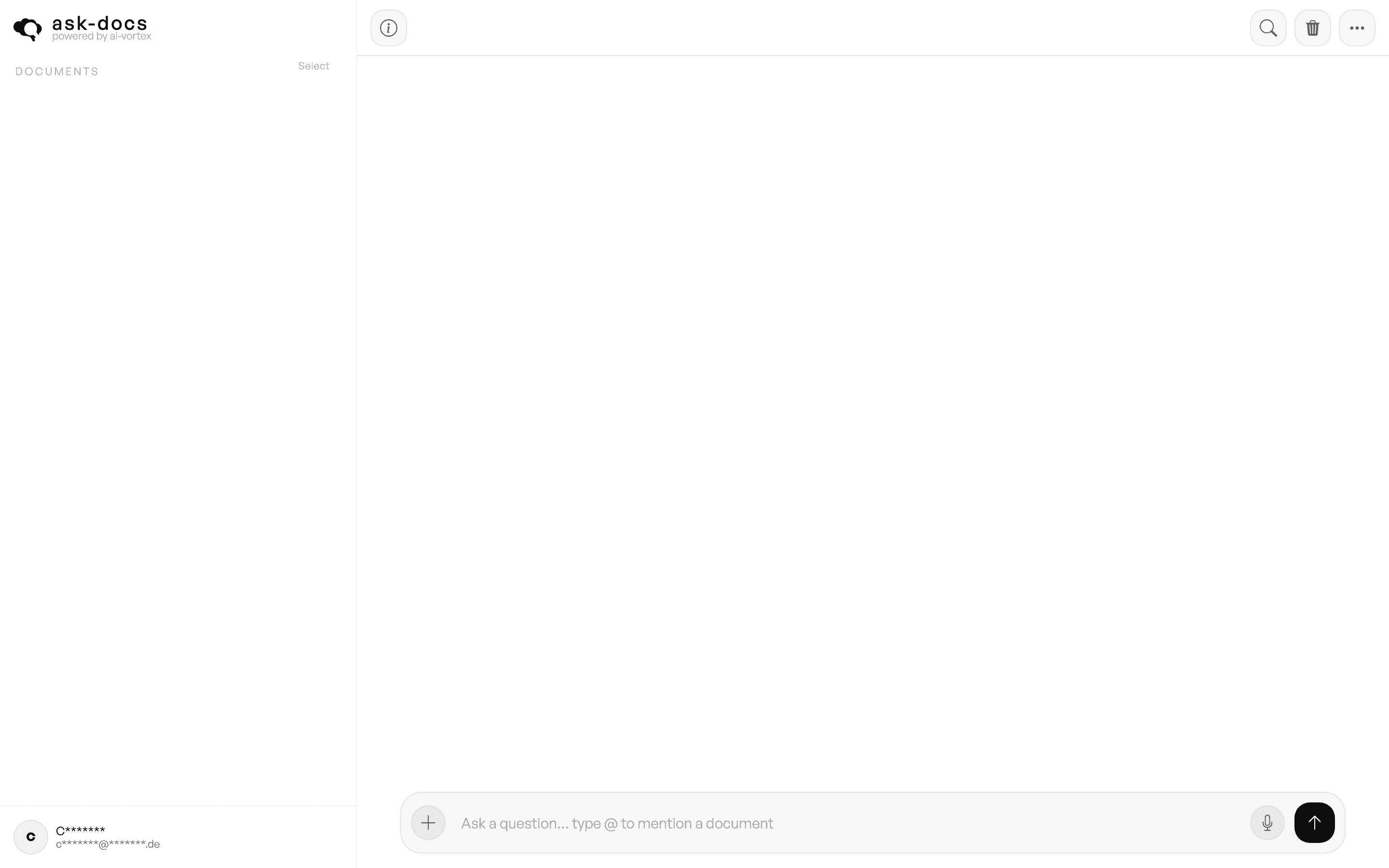
AI-VORTEX builds sovereign Company Brain infrastructure for regulated enterprises across Germany and the DACH region. Our Ask-Docs platform is deployable on-premise or in a certified EU cloud, GDPR-compliant from day one, ISO 27001 aligned, and operational in weeks, not months.
Book a free demo with our team and we'll show you exactly how Ask-Docs works inside your document infrastructure, no data required to leave your environment during the evaluation.